Work Notice Resignation Letter
Sponsored Link免费模板 保存,填空,打印,三步搞定!
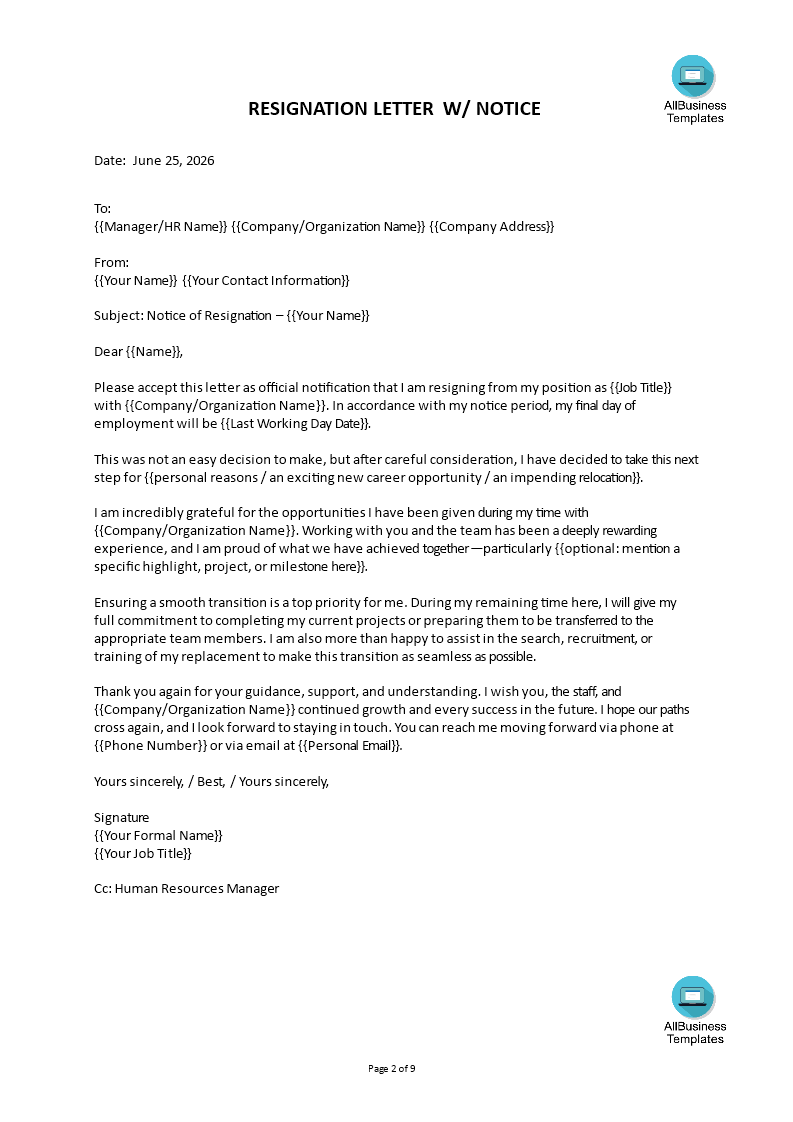
Download Work Notice Resignation Letter
微软的词 (.docx)免费文件转换
- 本文档已通过专业认证
- 100%可定制
- 这是一个数字下载 (39.5 kB)
- 语: English
Sponsored Link
When it is time to move on to the next chapter of your professional life, delivering a formal, written notice is a vital step. At AllBusinessTemplates.com, we provide professionally structured resignation letter templates designed to take the stress out of your departure. Whether you are relocating, accepting a new role, or leaving for personal reasons, our templates ensure you communicate your departure with absolute clarity, professionalism, and grace.
Whatever the circumstances of your departure, this Work Notice Resignation Letter can help you draft a polite and appropriate resignation letter. In general, a resignation letter should be a short letter, formally informing your boss that you are leaving your job and the company. Such an abdication letter can help you keep up a positive association with your company and boss by leaving with a solid and positive last impression, while likewise preparing you to proceed onward.
Do you need to write a thoughtful Work Notice Resignation Letter?
The Advantages of Using a Formal Resignation Letter.
Submitting a well-crafted resignation letter offers several key benefits for your career transition:
- Creates a Legal and Paper Trail: It serves as an official, written record of your intent to leave, clearly documenting your final day of employment so there are no administrative misunderstandings regarding payroll, benefits, or final payouts.
- Maintains Professionalism: Writing a letter helps you control the narrative of your departure. It ensures your message remains constructive, objective, and respectful, eliminating room for emotional misinterpretation.
- Simplifies the Transition: By outlining your notice period and offering to assist with training or handovers, you provide a clear roadmap that helps your team manage your workload after you leave.
- Understanding Common Notice Periods: A standard notice period gives employers sufficient time to find a replacement or redistribute their responsibilities.
- The Two-Week Standard: In many industries and regions, a two-week notice is the traditional benchmark for standard and entry-level positions.
- The One-Month standard: For executive, senior, or specialized roles, a 30-day or one-month notice period is highly common and often contractually required to handle complex project handovers.
Always check your local employment laws or your specific employment contract to verify the exact notice required for your position.
Why Keeping a Good Relationship is Essential!
Leaving a job isn't just about closing a door; it is about protecting your professional network. Exiting on excellent terms with your employer is crucial for several reasons:
- Future Reference Checks: Your next employer—and potentially the employers after that—will likely conduct background and reference checks. A glowing recommendation from a past manager is invaluable.
- Industry Networks: Industries are often smaller than they appear. Colleagues, clients, and managers move around, and maintaining a positive reputation ensures that your paths can cross constructively in the future.
- Boomeang Opportunities: You may one day wish to return to the company in a higher-ranking position. Leaving gracefully ensures that the door remains firmly open for future collaborations.
Please consider that it might cause some stress for the employer who needs to find a replacement. Therefore, it's important to give the notice in time (especially check with your contract), for example, two or four weeks, which is often an accepted minimum period of time.
We hope you made the best decision, and this Work Notice Resignation Letter can be of good use to you in order to write a polite and compelling resignation letter.
Here is a clean, consolidated, and highly versatile Resignation Letter Template created by merging the best elements of the versions you provided (professional notice, gratitude for the opportunity, an offer to assist with the transition, and contact information for staying in touch).
Good luck with your next chapter.
DISCLAIMER
Nothing on this site shall be considered legal advice and no attorney-client relationship is established.
发表评论。 如果您有任何问题或意见,请随时在下面发布

相关文件

Sponsored Link
